Friday, July 24, 2015

Artist Process: 'White Rose', Demo turned into a Work of Art.

'White Rose'  C.T. Rasmuss, acrylic - 14"x 18" (2015).

I hope you like what you see here!!!

 I meant to post this a few months back when I actually finished this painting after 3 short sittings.  I started it as a demo to a student of mine, during a 2 hour beginner class.  After the class I put it away for about week or so, until I took another look.  In order to establish artist process, you can see the original for yourself, which I've posted below...as finished in the class I taught:

"'White Rose' - 1st composition"   C.T. Rasmuss, acrylic - 14"x 18" (2015). 

You'll notice, all I did was add more layers, detail and mostly plenty of texture to my favorite part of the finished painting:  it's Blue vase!

This entire composition and floral was taken mostly from the top of my head, and partly from a few imitation silk florals that I pieced together for my student's lesson.  Upon reviewing the original condition of the Still life, my girlfriend agreed and convinced me that it was worth finishing; two sittings later I ended up with what you see in the 1st photo.

I also took a snapshot of the 2nd sitting, but had since then lost it somewhere.  Anyways, once I was convinced that I could do no more harm, the foreground & vase calmly found a place into my heart; so I framed it and a few weeks later was able to find it a new home in June.

Most importantly here, it wasn't the fact that I sold it to confirm the painting was absolutely finished, but it was purely artist's intuition I must say; and I stand by my work!!  I hope this helps you with any of your still-life painting's in question, new or old.


Monday, May 4, 2015

Daniel Carter Beard Bridge; 1st 'En Plein Air' of 2015


Today, May 4th was my first oil painting of 2015 that I'd attempted outside - en plein air; I intended to try painting outside this past winter in January or February to capture the beauty of virgin snow, but failed to do so, and making this victory that much sweeter!

The painting I posted above was just one sitting which I finished in under 2 hours today because I ran out of time, question now is: "am I done?" well funny thing is; as the alarm on my phone went off, telling me time was up: my last two brush strokes felt so good, telling me it was perfect timing to end it.

I could just as easily continue on this painting: adding detail, fixing lines, color, etc. but when it feels right, its right, and that's pretty much all I have to say..."on to the next" as they say.


This photo is where I was today and painted from, I was on a hill and had a great spot today, as I've painted this bridge a few times before.  There's one specifically that I did last year was on flat ground further up the bank, and it took more than one sitting; Although I didn't paint it at the river bank, but instead at home outside in my backyard.  

I just sold it last month and will miss it, but I'm definitely, as always, excited to move on in search of something better!


***After taking a quick break from writing this blog, unfortunately it has now come to my attention via my lovely girlfriend Michelle, that my painting could use a few finishing touches.  Ones that I could either agree with or dismiss, proving that an artists work is never truly done until they're completely satisfied, and due to this latest critique by such a treasured opinion, I must retract my: "when it feels right its right" conclusion and wait patiently til it drys; and try once again for a happy ENDing..


Monday, April 27, 2015

Picasso's 'Head': "It's a head, it's a head" and I Agree 100 Years Later.

Head  by C.T. Rasmuss, acrylic/found objects (2014).
What is a head?  Until I read The Watson Gordon Lecture 2008 with Neil Cox ; Picasso's 'Toys for Adults: Cubism as Surrealism, it never occurred to me to ask such a question.  This being, what is an object really?...especially one that we encounter on a constant basis, yet we're so unfamiliar and out of touch with at the same time.


"Writing about Head(shown below) in 1939, the then director of the MoMA in New York, described it as [o]ne of the most arbitrary and abstract of Picasso's cubist compositions in its remoteness of the object indicated by the title.  In saying this, Alfred Barr drew attention to the way the representation exists on the fringes of resemblance, and how strongly but awkwardly the title anchors around the representation to a certain kind of reading...Much later on in the 1960's, Pierre Daix discussed the work with Picasso.  The Dialogue went something like this:
Picasso:  'That's a head.'
Daix:  'That thing thing with the triangle?'
Picasso:  'But it's a head, it's a head.'"  
     Neil Cox (pgs. 10-11)

Head  Pablo Picasso, Papiers colles w/ black chalk, white gouache on cardboard (1913).

In reading this excellent lecture, I was able to directly relate a painting I did just last year, to Picasso's Head, and thereby received much gratification form it.  The fact that in it exists many properties that are in my work and to reassemble a such a work by such a great master like Picasso; I take great pride and it offers my artistic compass all the more validity.

Not only do I believe my 'Head' agrees with is, but I also have great comfort knowing that there is some part of the world out there that shares my thirst for discovery in a similar manner.  Here is another passage from the book that I believe wholeheartedly especially after reading it for the first time, is a great feeling as well:

"I General terms...to all historical works of art: how we see them is a negotiation between their presence, their persistence as physical objects that can be subjected to close scrutiny, and the structure of interpretation that have been developed subsequently in order to make sense of them...is never simple, since how we look, when we look at the work of art, is always structured or informed by our notions about it, notions that result from the history of previous interpretive language."
      - Neil Cox (pg. 22)

Closeup of 'Head' by C.T. Rasmuss (2014).

So I leave you with this: a closeup of my painting Head, and one last passage from the lecture on kid's toys, but first just a quick layout of what you see above: First you'll notice a round red nose, a clown might have with a light blue paint brush dividing painting into halves vertically, a place above where nose should be are two small, dark blue eyes, filled with emotion but hard to see via photo,then there is an angled foam brush intended as an eyebrow; I could go on, but I hope this passage by Baudelaire found in the lecture, that I leave you with helps; and that some day you may see it in person with this in mind(this goes for either Head )..

"The child twists and turns his toy, scratches it, shakes it, bumps it against the walls, throws it on the ground...at last he opens it up, he is stronger.  But where is the soul?  This is the beginning of melancholy and gloom."     
            -Baudelaire

Perhaps through art, it's possible to regain our innocence by throwing ourselves into something that is not meant to be thrown around like a senseless toy, but admired for its mystery now that we're adults.
    -C.T. Rasmuss


Friday, January 2, 2015

Frank Stella Resolution: Happy New Year 2015!

Serpentine Belt  C.T. Rasmuss, Enamel/acrylic/found objects (2014).

Let me just say up front that: like any other piece of artwork that's lavished with texture, my 'Serpentine Belt' shown above, is better seen in person, more so than other of my paintings like it; This aside, it will act as the anchor for my New Year's Resolution of 2015, which is: this will be the first of a solid series that I'll focus on throughout out the new year.  

Reason being, to create a more consistent point A to B resolution in my art this year; in the spirit of "Frank Stella's Black Paintings series", which I've provided a link to a good article on his early works and an example of his Black Paintings series which: "first announced him to the art-world of New York":


Marriage of Reason and Squalor   Frank Stella, aluminum paint (1959).

Of course my (Jackson Method) action painting, Expressionistic style is the opposite of Stella's Color Field - Abstract Expressionistic style, this is no matter, as what I mean to take away from his example, in his series and other ones of his like it; is his focus on a common denominator, resulting in tangible results that clearly showed up in his subsequent series, which introduced evident new ideas and techniques.

* fascinating to me how Stella's "Black" series varied very little from one to the next, but were profoundly different at the same time..

In other words...If I'm more focused in a specific series such as this one due to my Resolution, it should allow me better discipline, less distractions, and a clearer goal in mind; even though I still have the slightest idea where it will go.  And just like all artists it takes much faith to realize your efforts, and ensuring that they will be worth while.  

Serpentine Belt - closeup  C.T. Rasmuss, Enamel/acrylic/found objects (2014).

Don't get me wrong, as an artist I can focus very well, and I wish to focus on one specific idea that's simple and basic; and I wish to incorporate it through slight/varying applications, from one painting to the next, where non one is the same, and none too different so much that I end up going off into an entirely different direction(but if it happens it happens, I will just set it aside for some other time).  

The element that will be my common denominator, is going to be the new final line composition: as shown above in a closeup of 'Serpentine Belt', is the solid black enamel line over gray acrylic line, which pulls it all together.  I introduced this aspect in this painting for the very 1st time, and I myself believe it's an element that's entirely new in this very style of the Post-Pollock era; which I've been working on here n there over the last year or so.

In closing I'd have to believe that it's easier to stick with one way of doing it in Stella's Minimalist technique, than my chaotic action painting style, but what they share is: this approach makes it easy for an artist to get stuck, just like Pollock did, whereas Stella was able to move forward because of it; and talking to artist friend/colleague, John Sousa, perhaps if Jackson wouldn't have hit that tree, he may have broke on through, which is what I intend to do for him..proving that this method can work work for any artist, I guess you can call it a method of micromanagement or connoisseur-ism, benefiting the artist in a painterly way tho.


Here's to progress in 2015!  &  A Happy New Year!!!


Monday, December 29, 2014

Madonna with Child; A Contemporary View of its Renaissance Form.

*to be titled at a later date*  C.T. Rasmuss, Marker layout for Lucid Mosaic (Dec. 2014).
Lately I've been studying the Renaissance, the most I have since my courses in art school; this is all due to coming across and watching: 'A History of European Art', lecture on DVD(The Great Courses) by Professor William Kloss.  


I've provided you with a link to it, as a resource which I keep renewing mine at the local library, from this course midway through the 48(30 min.) lectures, I've been inspired to finally attempt my rendition of Georges Rouault's, Madonna with Child(painted in 1920,but of a of a different name), which I saw and sketched quickly at the Dayton Art Institute, shown below:

Sketch of Rouault's Our Lady of the Fields C.T. Rasmuss
Even before visiting "The Dayton" my 1st time, I'd already been influenced and mesmerized by Rouault's stained glass quality to his oil work(as he served as a stained glass apprentice in his youth), I'd also become to admire his authentic texture, and especially his subject matter(uncharacteristic of his Modernist peers art work, for the most part) along with his extreme empathy for these subjects, almost to realized ecstasy.

Notre Dame des Champs NO. 4  Georges Rouault, oil (1920).
As you can see, I got the gist of Rouault's "Masterpiece", and last week when the spark hit me, I got the urge and grabbed the pre-fabricated canvas, and started drawing; from the very day I first saw, realized and sketched Rouault's "Madonna", I knew it was going to be one of my Lucid Mosaics, but I just didn't know when.  To be even more specific, it was going to and still is going to be my first Lucid Mosaic involving a composition, that deals with a portrait setting:

*to be titled at a later date*  C.T. Rasmuss, drawing (Dec. 2014).
I'm not sure if this was on purpose or not, as it can take a lifetime to understand the lifetime of the great masters, so I wouldn't put it past Rouault, as it was obvious through his unique Renaissance subjects, that he must not have only studied the great painters of the period, but also their inventions and hidden ideas that they introduced and perfected.  What I'm saying here is: in coming up with my own composition based from Rouault's, nearly 100 years earlier; I've noticed and capitalized upon an important central idea, found throughout much of Renaissance art, and that is the Trinity.

Trinity diagram   C.T. Rasmuss, ink.
In comparing my painting/drawing to the Rouault's original, the above Trinity triangle that I drew, overlaps our two paintings together by its central figures: Madonna and Christ child; with the top point rotating clockwise: 1. Mary's head, 2. Christ Child's head, and 3. is where they connect(Mary and Child).  

All in all, it was an innate need for me(capturing the essence of bond between these two figures above all other aspects), I feel lucky that I was able to carry this most important aspect(representation of the Trinity composition wise) over into my own interpretation of an artist's great & successful rendering of this heavily sought narrative; also with a similar need to communicate this age old subject, I feel blessed to have the faith in being able to just go for it.  Thereby receiving the reward of understanding, to which only this event could have given me!

To be continued..


Monday, December 22, 2014

Black Lightning by C.T. Rasmuss

Black Lightening  C.T. Rasmuss (2013).

If you like the picture of mine above, I thank you, but I'm sad to say it doesn't exist anymore, but it still lives on throughout parts of my Lucid Mosaics, where it payed the ultimate price and has now disappeared into other artworks of mine.  The reason I'm presenting this to you, is for the same reason I took a picture of it in the 1st place; as I saw it as a work of art all in itself, by itself.

When it comes to other artists and my will to create a comrade-re between us artists, on similar missions, I'm all in and hold nothing back, but when it comes to this particular process of my own design(and of course the blessings of a higher design), I believe that I must keep some things to myself.  

My Exhibit at Broadhope Art Collective over the weekend  C.T. Rasmuss (Dec.19th 2014).
So anyway, I was talking to another artist yesterday by the name of Michelle Gravett, and she had mentioned some particular textures that I incorporated in my 'Provincial Orchard', specifically(shown: far, lower right) and because we have different perspectives of my work; me being the artist, and her being an observer, via our conversation I better understood how my "tiles" look to everyone else, and why I now wish to share one of my favorite whatchamacallits:)

She said: "the sky looked like stone", and we analyzed it a bit(so to speak), and is why I had to share it with you, whether an artist, an admirer or just someone curious about art; what I like about my favorite "whatchamacallit", is it's resemblance to Lightning, the natural aspect within a man made process by yours truly, and as we can only emulate life I say: "the truer the better", in this case for sure.


Monday, December 15, 2014

White Canvas, Frames on a Wall, and a Palette Caught in the Act.

Palette Caught in the Act  C.t. Rasmuss, photograph with i-phone (Dec. 2014).

Last week, I was in the middle of painting some frames for an upcoming art exhibit of mine, which is now, this Friday; and as I was doing something with one of the more unfinished ones, I briefly glanced back over my shoulder, and this is sort of what I saw.  I didn't do anything to it(touch it or anything), I just left it as it was, and having the need to make this perception permanent, I did what any good photographer would do, I got my camera phone and took the shot.

And now I'm so glad I that I did!  I posted this photo on Facebook soon afterwards, and to a bigger reaction than anticipated, it got many likes, a share, and some commentary; so to sum it up: this photo was effective in making a point, but question is: "what that point(s) does it make"?  To answer: I'm not quite sure yet, but I think it goes deeper than first anticipated.  One of those shots I guess, that only comes from a mixture of intuition and the faith to take the shot!


When I was in art school down in Tampa, Florida(USF) about 5 years ago, I remember this girl in one of my conceptual art classes; we had our biggest assignment at the end of the year and remember putting lots of time into mine, as well as most other students in the class.  The reason I remembered this girl and the only reason she stood out was cause for her art assignment she had just placed a regular frame on a wall and that was her project, many of us all just looked at each other in disproving reactions mostly; as we all felt that she was grasping at straws, as the rest of us had put real thought  into our work and most of us took it seriously.  
This also reminded me of the 1st time I'd seen the White canvases on the top floor of the MoMA, when I attended Hofstra, a few years before USF; and I can't help but think that my photo is a result of all these factors.  The two photos above are obviously pictures of frames, meant for their original purpose(top photo), and for interior design(bottom photo)and not in the name of Fine Art in my opinion.  

*

*I'm unable to cite these two works of art, as the sites I'd gotten them from, hadn't cited them either*

 *

Once in one of my sculpture classes at USF, I "accidentally" spent many hours on a White canvas of my own, which started out as a gigantic hard surface canvas for sculptural purposes, but ended up as a "White canvas" for my final critique(one in which my professor said was better than most graduate exit critiques). 'Palette Caught in the Act' raises at least two questions: "Is the White canvas, Fine Art?" and "Is a frame on a wall or around a palette, Fine Art?"; my answer to both of these is: "depends on the context they're in..".  As an example, based on my answer, the first two photos, again are not Fine art...but the second two are!  

The second grouping fits the category of Fine art because: the top photo is a frame that is deconstructed, then reconstructed into a completely different composition, where the artist seems to be trying to make an artistic statement; and the bottom photo is more obvious, as its actually in a Gallery, where it still can be disputed, but that's a different argument.  

As for my photo, I will defend my increasing like for it, by stating that: it's an original concept as far as I'm aware of, I meant to make an artistic statement by taking the photo(a composition that no longer exists within 10 minutes of "taking the shot", as the frame is now in use and the palette is back to being just a palette), which defines my statement: The Metaphysical Argument.  What that is specifically, we may never know for sure, but it's why I took the shot; our need to explore further into the void..

White Canvas 2  Robert Rauschenberg

Shown above is Rauschenberg, sitting in front of one of his White canvases, I can't recall who the 5 or 6 artists at the MoMA were, but this one was brought to my attention by my artist friend John Sousa.


Monday, December 8, 2014

Mazement: Finding the Cheese Again.

Mazement   C.t.Rasmuss, oil (2014).

I can't remember the mood I was in when I set out to paint the above oil abstract, that I finished a few weeks ago, but I can say that the drawing on the canvas about a month before and it just sat there ever since.  Since then I'd been like a deer in headlights, and every time my eyes were cast upon it, it reminded me more and more of my laziness, frustration, vexation, annoyance, or being stumped(perhaps all of them at one point) and this is all I can remember and why I chose this particular painting today.

Because this is also how I feel today, not 'Mazement' as in amazed, but just the opposite: suck in a maze, today I contemplated earlier, hear at a place I frequent for coffee and WIFI, and where I show some of my work; where I picked up four of my artworks today from November's show, as soon as I saw the two large ones leaning on one another face to face(the smaller two in the same fashion I later found), I was instantly offended, I felt immediately that the person in charge of this: 1, has no idea what they're doing and either 2 has no real regard for the art-work.

No matter the actual truth behind it, I got a feeling that my art-work(style) was probably completely misunderstood in such a place, and therefore: I drew a quick conclusion that perhaps it has no home hear or anywhere really; so now I contemplate: "Should it Matter?"(there's a good chance that I could be mis-reading the entire situation); but at least I know I could never twist my talent and make work just to sell - this is entirely out of the question to fix this problem, and as a result I'm faced head on with: the difficult choice to continue on with no promise, nor any clear direction, into the Abyss I feel...lol!

Some days this journey is "on hold", some days I jump in face first, some days it just happens natural, and some days, like over this weekend, it beat me up pretty good, so the question is: What kind of mouse will I be today in this Maze?;  I'd say the same goes for all of us, so...how bout you?..what will you get done today?  As for me, tho minimal, I've at least gotten started...gotten over that hump or around that 1st turn, and hopefully I just might find the cheese again, even if its just for today, F it!!!


Friday, December 5, 2014

Paul Signac and I, Brothers in Art.

Remake of Signac's: Pont des les Arts 1928 by C.t.Rasmuss, pencil/gouache (Nov. 2014).


I just over heard a brief conversation between an artist and the manager of a local place that holds exhibits, where I'm at for the WIFI and coffee, in order to make this post, and right as I was placing the above image: Remake of Signac's Pont de les Arts 1928, by yours truly...I heard the artist contemplating out-loud to his manager, about a current process for his new piece he's working on.  What got to me was his resolution in this conversation, this being the essence and conclusion he'd drawn from their encounter, which was: "...depends on what people want to put in their homes..".

Wow!!!  This comes as a shock to me and at the same time as a revelation: people/fellow artists, are 'we' this shallow?  To compromise everything we do, and are, what we represent, just to please others, merely for the chance they might give us a bit of cash?  If so, then what's it all for?  I mean, it embarrasses me to ever think ourselves to be in the same category as those great innovators of the Renaissance, especially those who painted without a license, risking their lives to express their freedoms and beliefs, as well as many other generations of artists, fighting a cause, big or small.  Hearing an "artist" talk the way this artist did just now, really offends me; and opens my eyes even more to a generation filled with others that feel this same way, paint this way, and base their life's work on(excuse me but) such a slutty principal!

Now don't get me wrong, if this is a hobby for you, or your painting for a loved one/friend/family member, etc. and you're keeping in mind what they'd like, etc. I respect you for it, but when money's involved; other than even perhaps a much needed commission for professionals, this doesn't include my contempt, but I would like to say even to these commercial artists and commissioned pieces: they too should have a certain freedom from outside influence, in sake of truth, over money, but that's just me(hopefully til the grave).

Thumbnail of S's: Pont des les Arts 1928 by C.t.Rasmuss, ink (Nov. 2014).

People!  I swear to you, I was here at this same place last week for the same purpose and read a coffee-table book: 'Master Drawings Rediscovered' by Ilatovskya; The State Hermitage Museum, St Petersburg/Abrams.  and in this book I saw many drawings and watercolors by Signac, more in one book than I'd ever seen before; I've known about his pointillism long before his drawings, which most people know him for of the former; so upon seeing this: I was inspired to finally make attempt of my own, not because it: "...depends on what people want to put in their homes.", but because, coincidentally I'd been in search of a composition by this same Master for my next Lucid Mosaic, I did it entirely for myself.

Drawing for Remake of Signac's Pont des les Arts 1928  by C.t.Rasmuss, pencil (Nov. 2014).

The Mosaic's I do are especially for me, my belief in God's gift he's revealed to me, and I believe all of this to be true because it's our collective duty to push beauty further(or point out where we fall short maybe, being the other-side of the spectrum), among others.  And if none of it ever gets it due, well then that's not my problem.  "I tried my best", which is what I hope I can restfully say someday, old and gray.

So the compositional source I used for my Remake by Signac, had a bridge, something I hope someday to incorporate into one of my mosaics, as they evolve in complexity; for now it's just nice having an excuse to paint a bridge anyway, the bonus here is using my innate gouache style, which you'll see is why I feel such a strong attraction to Signac's drawings.
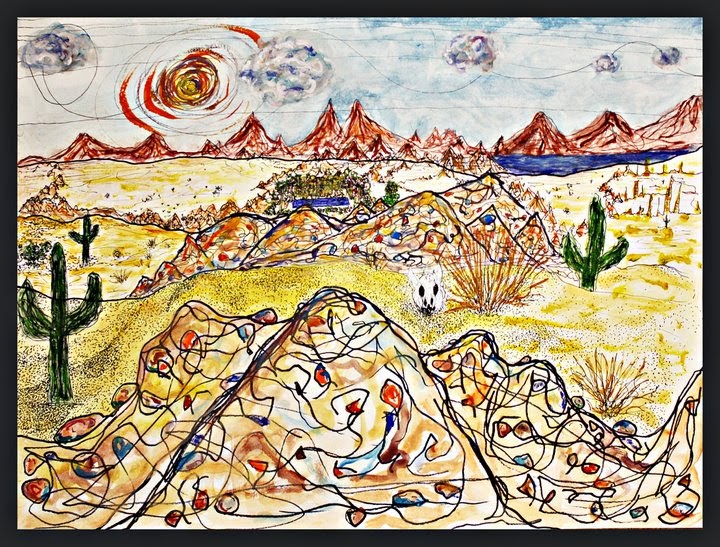
Palette in the Dessert  C.t.Rasmuss, ink/gouache (2010).

The above painting is a landscape straight from my imagination, and done before ever seeing Signac's unique style in watercolor/gouache, making us brothers in art some how:) 

Bank of the Seine Near the Point des Arts with a View of The Louvre  Paul Signac, pencil/watercolor/gouache.

Pont des les Arts  Paul Signac, oil (1928).

The 1st of these two paintings by Signac, is one of the drawings from the book I mentioned, and the second is the oil painting that I drew the actual remake from; this oil of his seems to me more of an example of: Post-Impressionism than his Pointillism, which he famously helped develop after the death of his mentor, Georges Seraut.

>Follow this link to view more drawings by Paul Signac<

Saturday, November 29, 2014

Rockwell Kent's Adirondack Landscape 1940; Under The Giving Sun in 2013.

Under The Giving Sun  C.t.Rasmuss, lucid mosaic (2013).

Rockwell Kent's: 'Adirondack Landscape from 1940; I first came across this painting last year at The Dayton Art Institute(and a few weeks ago I was able to re-visit and take the photo this time); I'd heard of Rockwell Kent before, but just his name, not much more than that, but when I came upon this painting, instantly I had to draw it! As I quickly sketched it, as usual, with any other work of art, I started to learn more about it's composition, simple as it may have seemed; as it was just a landscape with trees, a sky, and clouds. Even so, I became more and more interested in the unique styling of these common, compositional elements; which later without foresight, became the focus of a 200-150 hour labor intensive lucid mosaic.

Adirondack Landscape  Rockwell Kent, oil (1940).
 These compositional elements which I'm referring to the: trees, shrubs and clouds(which I did not end up including in the final artwork) caught my eye and gave me the idea to turn this composition into my next lucid mosaic. The trees, which were my favorite part overall, are how they seem realistic, but have exaggerated openings allowing the landscape to pierce through; this shape-like characteristic allows for unique and organic objects possible, to be included in one of my mosaics; this goes for the shrubs as well(and clouds if I'd included them).

Three Hills  C.t.Rasmuss, lucid mosaic (2012).
 When it came to the clouds, I had changed my mind near the end, they just didn't seem to be enough anymore, so I replaced them with a “majestic” sunrise & sun-rays, for an “East meets West” touch. I believe the need for this change was caused from the extra row of trees/shrubs I place on the secondary wave of landscape; I did this to create and existential component, as I believe Kent's original had a touch of it, and as an artist in the 21st century it's my duty to try and improve on any work, or movement by the master's.

Click here to learn more on artist: Rockwell Kent

Original sketch at Dayton Art Institute by C.T.Rasmuss, ink (2013).


Friday, November 21, 2014

To Paint or Not to Paint..Ecstasy of St. Francis at Dayton Art Institute Leads to Crossroad.

To Paint or not to Paint  CHAD, oil (2013) Artist's private collection.

This painting, I rendered from a sketch that I did as I saw a kid getting out of school, he was admiring a small grouping of wild flowers, that seemed to be growing out of place as far as I was concerned; I was stopped in traffic on a two lane road at the time.  Once I noticed the kid in this tiny "field" of wildflowers, it struck me as odd, because it was  in the middle of the city and this kid seemed intensely drawn in, without care to anyone, or anything around him in this busy, bustling of our everyday city life; so I quickly grabbed my handy sketch book and did what I could, as something told me not to let this moment go.

I'd been struggling to come up with ideas or the energy to paint at this time, and it took many months til I actually revisited this sketch, if not a year, and when I finally did, it was my first return to oils in almost 5 years.  I believe my first true experience in art, was in oils, where I felt I could do anything that the best artists of the past could do; I was able to relate this kid's experience with the wildflowers (a rare action in my opinion, especially for this absurdly, modern world) and translated  it to my canvas!

The buildings in this painting were my favorite part, as I couldn't recall them from memory, or sketch their accuracy fast enough that day in traffic; my main objective was to make the buildings in a way that they were completely inanimate to create a space that was imposing yet powerless against the object of focus, a way of portraying how buildings seem to have more importance in the developed world than individuals and their interaction with nature; I also made the person(best to my ability) allowable for anyone to claim it's identity.

The sketch happened in 2012, painting in 2013, and here now in November of 2014, I've for the 1st time studied in depth, Italian Painter, Giorgio De Chirico, considered to be the greatest Italian painter of the 20th Century, founder of the Metaphysical movement and the main influence & contributor to the Surrealist movement that followed in the mid to late 1920's, here's an example of a favorite of mine, 'The Great Metaphysician':

The Great Metaphysician  Giorgio De Chirico, oil (1917) The MoMA.

His faceless characters and Neo-Ferarra architectural set the stage for a space that he can easy manipulate for scale & effect, for me it also has shed new light on a oil painting I did over a year ago, a painting that's been in the back of my mind ever since; I always thought it wasn't finished and now realize somehow, that it is, it's just not a finished idea, but the beginning of something special I think.


Kenneth Branagh as Hamlet; "Gravedigger Scene"

Selections from Hamlet: Modern Translation; written by Shakespeare (1599-1602).
Act V scene i

Gravedigger Here’s the water, right? And here’s a man, okay? If the man goes into the water and drowns   himself, he’s the one doing it, like it or not. But if the water comes to him and drowns him, then he doesn’t drown himself. Therefore, he who is innocent of his own death does not shorten his own life.

...later in scene after Hamlet and Horatio enter the graveyard in which Ophelia's to be buried..

Hamlet That skull had a tongue in it once and could sing. That jackass is throwing it around as if it belonged to Cain, who did the first murder! It might be the skull of a politician once capable of talking his way around God, right? And now this idiot is pulling rank on him.

Mel Gibson as Hamlet; "Gravedigger Scene".


You might be asking yourself what does Hamlet and these selection from the play have to do with De Chirico and my painting?. and I too was, until just now when upon blind faith I've realized: "the skull", why it may be so "Iconic" to many people, especially in Hamlet, out of all the symbols, from one of the greatest plays in Theatre?

Despite being part part 1/2 Irish, 1/2 Danish decent, my last name being Danish: Rasmussen, Son of Erasmuss; before knowing this fact, I've been attracted to the story of Hamlet most of my life, whether its through watching the play, a movie, artwork(Van Gogh's Skull of Skeleton with Burning Cigarette, Seen below), reciting Hamlet's most famous soliloquy in college as a theatre major, or studying Tom Stoppard's adaptation: Rosencrantz and Guildenstern.  

And now I realize how Hamlet himself relates to the ambiguity of the skull's identity, in perhaps my favorite scene; as it was once alive, a skull that we all have in common, of course among other things we have anatomically in common, but directly linked to identity in this case more so than any other "bone" in the body.  This relationship between Hamlet's interaction with the skull that the gravedigger digs up, has led me to the ambiguity of identity throughout De Chirico's masterworks, and also my: 'To Paint or not To Paint', as I've now finally come to title it.


Upon visiting the Dayton Art Institute, which sparked this entire assemblage, I drew a detail, sketch from Italian Renaissance painter, Bernardo Strozzi's 'St. Francis in Ecstasy':

Ecstasy of St. Francis  Bernardo Strozzi, oil (1615-18) Dayton Art Institute.


Detail of Strozzi's "Ecstasy of St. Francis" (Nov. 2014).

What I really like to point out in this detail is the comparison to De Chirico's 'The Great Metaphysician', how the pedestal, vertical style is where I see and evident crossroad; which will be clearer for me after, perhaps what I'm able to derive artistically from this, as De Chirico had a respect for the Classicist painters and the Masters as so do I, of course we differ in many other ways, but this is just a momentary crossing, then for me to go on my own way.

So when I go to the museums I usually sketch everything in its entirety, the best I can, rarely do I just focus on a detail, and usually its floral patterns or detail work; in this case I drew the detail in a way that, would make Cezanne proud as I sacrificed its actual composition for what I actually see, which really wasn't there(or was it?).  While drawing this, I was inspired in the oddest way, and couldn't figure out what to do with the detail, and still can't really, but I believe whatever and whenever I'm inspired to take this further, it is a crossroad, and that crossroad for me just might be the Skull..?..as Strozzi did over 40 paintings on the subject of his muse: St. Francis.


Saint Francis' religious life reminds me a lot of Van Gogh's painterly life, separated by 700 years, I'm sure Vincent was aware of St. Francis and his sacrificial life style, which may have influenced him along his desperate journey to get closer to God in his own way.

Skull of a Skeleton with Burning Cigarette  Vincent Van Gogh, oil (1886) Van Gogh Museum.

 Ever since seeing Van Gogh's Skull with Cigarette above, upon seeing it for the first time, even 2nd and third, I couldn't believe that anyone had ever done such a thing over 100 years ago, let alone 50, I've been fascinated with this "surreal" image that was way ahead of its time, especially when you think of how people never knew smoking was bad for you lol!

Pyramid of Skulls  Paul Cezanne, oil (1901) Private Collection.

And last but not least, today is the 2nd time coming upon this work by Cezanne, it's a prominent work, and out of all artists I'm glad it's Cezanne because of his ingenuity reassures me, that I'm at the right crossroads; fingers crossed...x.x..


Friday, October 31, 2014

COLLECTIVISM: A Movement of the Here and Now; Powered by The Collectivism Coalition.

Collectivism-  A collective way for artists to discover their creativity, together. This artistic movement in the infancy of the 21st century, looks to bring a taste of the early Modern Art Masters, into the here and now....We are looking for artists who have been influenced by Modern Art from the 1900s to present day..
         -Paulo Guimaraes(co-founder)


Winter Landscape  Pablo Picasso, oil (1950).

Tulips and Oysters  Henri Matisse, oil (1943)

The paintings are from two of the best known Modernists in the 20th century, Pablo Picasso and Henri Matisse; I posted artwork by them to demonstrate how much of this new movement we hope to inject into today's "loose" art world, will likely revolve around them(or similar artists) directly or indirectly somehow.

These particular two artworks are also famous for being part of many trades between the artists(the same open relationship encouraged under Collectivism), according to Picasso, his 'Winter Landscape' may have been Matisse's muse for the chasubles in his Venice Chapel; and Picasso chose Matisse's 'Tulips with Oysters' because: "he didn't understand it".

This relationship between the two Masters highlights what Collectivism is all about, it's a movement that doesn't revolve around today's mentality of pure individualism nor the attitude instilled into art students that: "every other artist is your competition"; but that without other artists, there is no art, so why not take advantage of possible relationships with other artists, especially with the Masters who've left their mark for a reason!

Collectivism is not naive in saying that everyone be "buddy buddy", but that we admit our differences, put them out into the open(w/o fear), and not to be afraid of criticism or a little friendly competition, to adopt a mentality of: "that which doesn't kill you makes you stronger", we believe that the art-world of today simply needs a little(lot) more togetherness, revisit the past & push each other toward the future.

For more interesting reading on the relationship between these two Modern masters, I have provided a link below: